Orienting new design students through board game play
Finding our problem
First-year design students felt lost: Literally and socially.
With a focus group, we found that they didn't know where classrooms were, had little connection with upperclassmen, and had no sense of what to expect from future coursework.
Game goals
Foster community and learning
Familiarize design students with each other, the department’s layout, and the degree’s cirriculum.
Keep players engaged from start to finish
No players getting “out” and having to spectate. Even if you lose, you still get to have fun.
Create a collaborative player environment
An energetic atmosphere where players ally, collude, and compete against each other.
Drawing inspiration for an exciting, thrilling, and chaotic gameplay
While writing the rules, we knew we wanted to create chaos: where everyone is yelling and hollering. The type of energy when your friends bring UNO, but everyone has different rules.
So we looked at games where you outmaneuver, plot against, and then conspire with your previous opponents.
Games with a "secret killer"

Werewolf

Among Us
Games where you “switch sides”

Sharks and Minnows,
(a swimming pool game)
The starting point
Setting the game’s core experience
Knowing we wanted to created a board game based on the department and using our goals as a reference, we defined our game’s fundamentals to help us guide every decision onward.
Games with a "secret killer"
4-10 Players
Avatars based on student stereotypes each with unique advantages & disadvantages.
Students complete tasks to escape
To escape the floor, student players must first complete Loyola-design-based tasks across the board.
The Ghost picks off students
A hidden ghost player works to “kill” students while they do their homework.
“Dead” students return as ghosts
Students killed by the Ghost become ghosts themselves and play to target students.
Game dynamics
Writing rules that are exciting yet balanced
With the basics down, we now had fill in the gaps between them, all without gameplay becoming confusing or some part being overpowered.
Games with a "secret killer"
Every rule, avatar, task and edge case dynamic was written and then measured against the rules written before it.
If a new dynamic created conflict, one of them had to be either scrapped or reworked.
The first play
Pilot testing our low-fidelity prototype
To allow us to fine-tune spacing, room arrangement, and game dynamics, we used modular rooms and paper cards before committing to official graphics and board composition.

Players took way too long to cross the board
Too many spaces and moving pawns with the dice-roll method slowed gameplay. By making each square larger (resulting in fewer spaces), players crossed the board faster and maintained gameplay momentum.
Ghosts moved too fast and eliminated students too easily
We let ghosts to move through walls, but that allowed them move too fast compared to students. To strike better balance, we imposed limitations on ghosts movements and added slide spaces for students.
High-fidelity prototype
Bringing our game to life
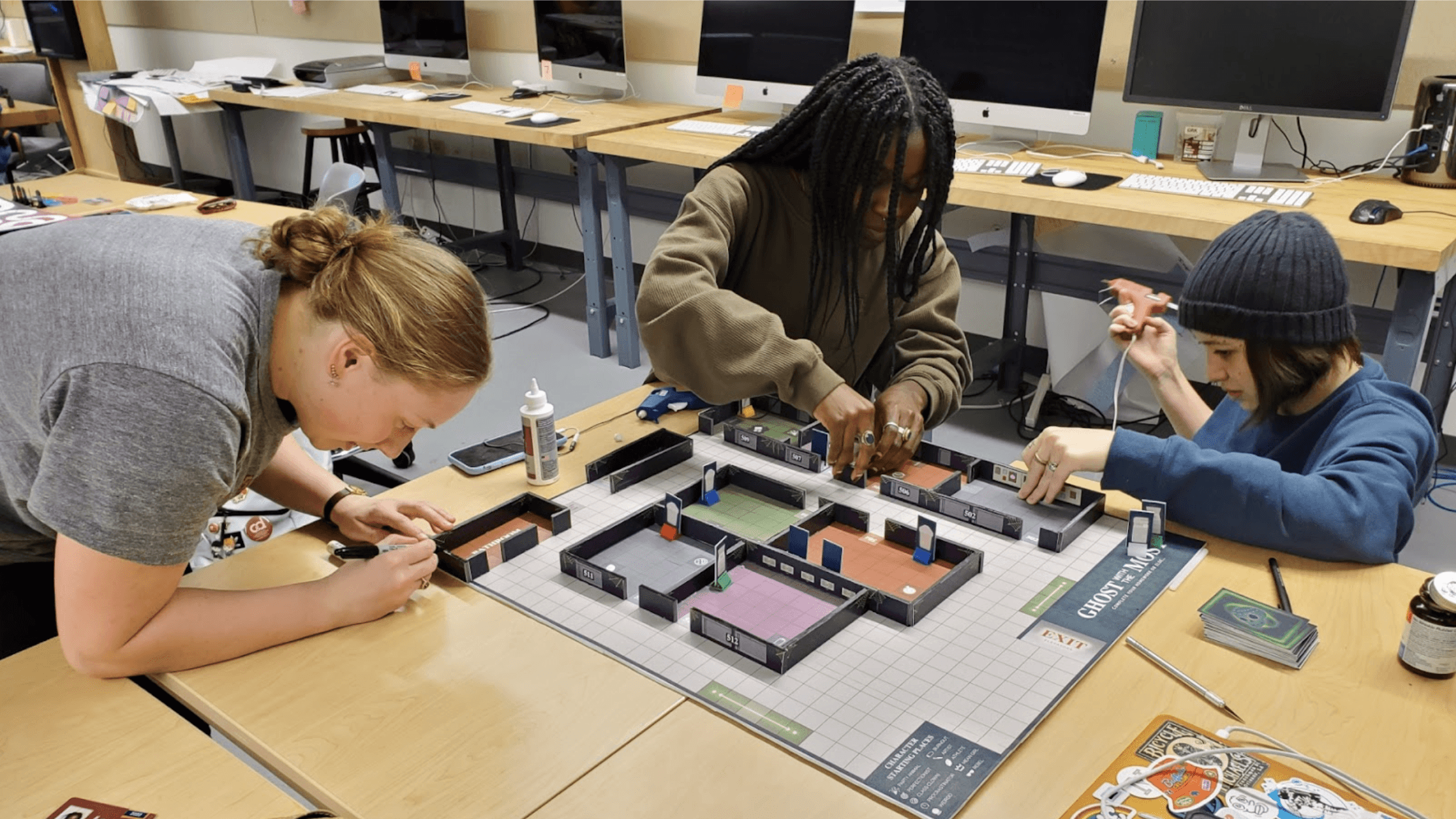
To make the high-fidelity game, we divided and conquered to design our components (board, characters, walls, cards) and source game pieces.
Games with a "secret killer"
Then, we assembled our large board: printing small graphic sections piece them together like puzzle pieces on a firm foam core. Next, for our walls, we cut leftover foam core then applied paper graphics. Each wall was then glued onto a placeholder spot I created while designing the board graphics.
Official playtesting
Finally, a complete game was ready for play
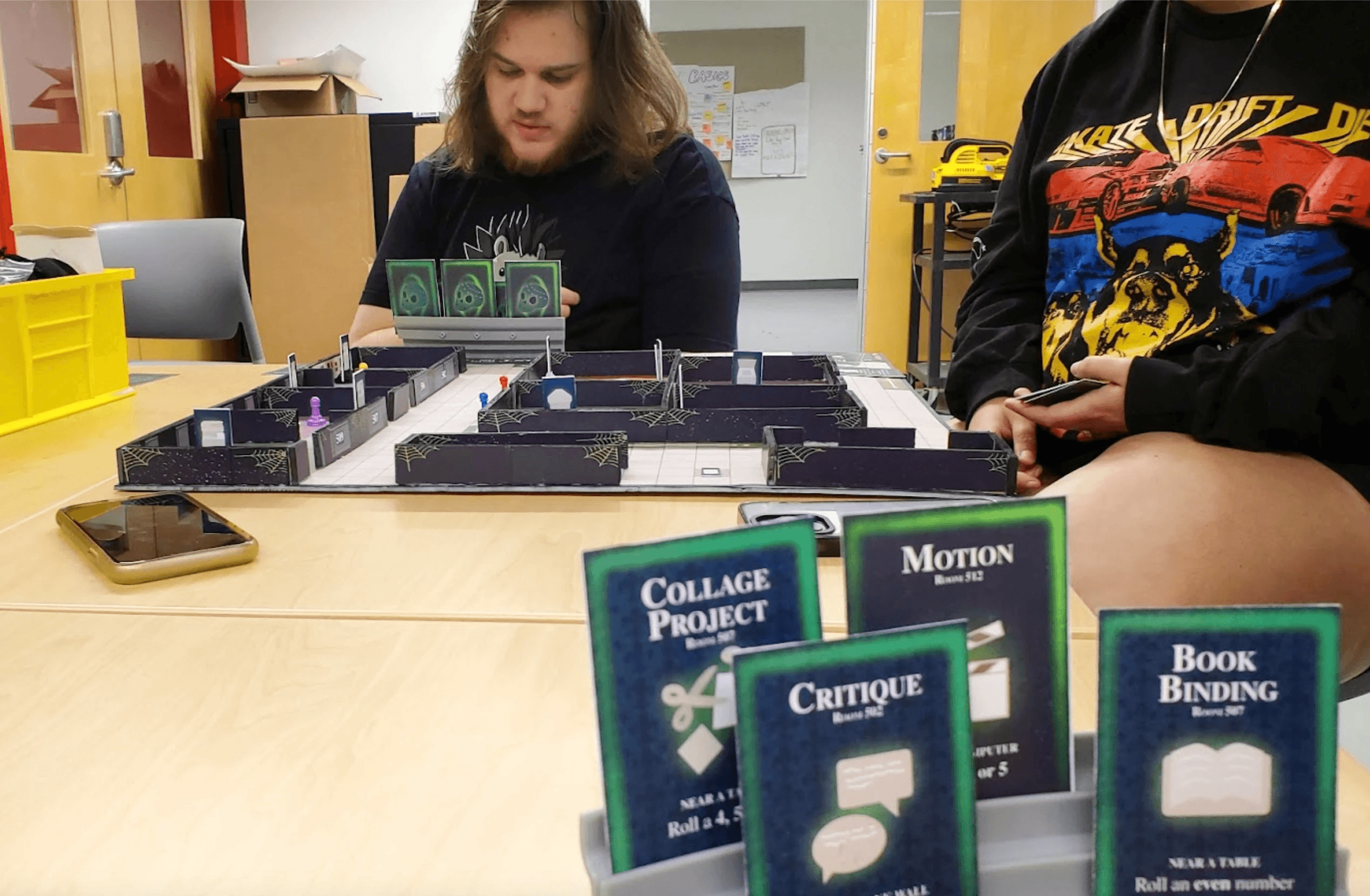
We set the board up, explained the rules, and watched our players get started. During the game, we allowed the players to ask rule-clarifying questions to which our team 1) responded with vague answers to gauge players’ thoughts, and 2) eventually clarified rules so the game could continue.
Gameplay observations
Addressing playtesting feedback for a game even better than before
After a handful of rounds with our high-fidelity game — and lots of yelling and laughing — our players expressed that they enjoyed experience. It was thrilling, existing, and collaborative (just like we’d hoped). However, we observed a few areas for improvement.
Students didn’t have enough ways to evade ghosts
Slide spaces helped students evade ghosts for longer, but they were still at a disadvantage. Here, we added secret passageways so students can jump entirely across the bored for a fairer power distribution.
Creating more energy with student resurrection
Gameplay was enjoyable, but few students escaped before the ghosts usually won. Listening to the wishes of our players, we enabled students to resurrect each other if they were in vicinity at the time the other is “killed”.
Final game
How to Play
Upon the game’s start, players select a student avatar and are dealt homework assignment cards, with one ghost "task" card hidden among them.
Students must complete their homework to survive and escape
Student players maneuver the board to finish their homework through dice-rolls and working with other students. After task completion, students can pick up the exit keycard to escape through an exit.
“The Ghost" must turn all students into other ghosts to win
The player dealt the ghost task card becomes the first "Ghost" and must eliminate the students with an odd-number dice-roll in close proximity.
“Dead” students return as ghosts or have a chance at resurrection
Students killed by a ghost rejoin the game to become ghosts themselves and play to target students. If another student is nearby upon their “death”, they can resurrect the dead student with an even dice-roll.
Outcome
Looking back at our goals
With more revisions again post-playtesting, we were able to create a thrilling, energetic, chaotic game that met our initial goals: